|
|
|
![]() |
|
7 QC TOOL FOR QUALITY IMPROVEMENTS
(Using Microsoft® Excel) |
| |
|
iNTRODUCTION
: |
|
“The
term “7 tools for QC” is named after
the 7 tools of the famous warrior, Benkei. Benkei
owned 7 weapons, which he used to win all his
battles. Similarly, from my own experience, you
will find that you will be able to solve
95% of the problems around you
if you wisely use the 7 tools of QC.”
- ISHIKAWA KAORU, Professor Emeritus, University
of Tokyo
|
 |
|
|
| |
|
Dealing with quality problems can be similar to being lost. You don’t know where you are. In quality improvement process, problem solvers need to know where they stand, what the problem really is, and what the cause of the problem is before any solutions can be proposed. Problem solving should follow a logical, systematic method. This will place emphasis on locating and eliminating the root or real cause of the problem. Other, less systematic attempts at problem solving run the risk of attempting to eliminate the symptoms associated with the problem rather than eliminating the problem at its cause. Organized problem-solving efforts utilize a variety of quality tools for problem analysis. The 7 QC Tools are scientific management tools, which are basic and easy to understand. They form the fundamental & critical foundation for all problem solving and quality control activities.
MAJOR ADVANTAGES:
In addition to providing participants with the concepts and critical foundational 7 QC Tools usage, this program also teaches participants to construct those QC Tools accurately & fast using Microsoft Excel® spreadsheet software. By doing so, it brings participant’s knowledge/skills to speed and allow more time in the class to focus on interpreting the results, recognizing the fundamental workings of the tools, and establishing action plans for the improvement of quality. This training program provides the critical foundational skills and is a must for all employees involved in problem solving, quality control and quality improvement activities.
NOTE: Value-add MS Excel working templates will be provided for the participants to practise hands-on. With this valuable tool, participants can immediately put to use all the QC tools in their workplace.
|
|
| |
|
|
|
|
|
|
|
|
|
At the end of the course, participants
will be able to:
-
Use and recognize the power in each of the
7 QC Tools
-
Construct the tools (manually and fast paced
by using computer spreadsheet software)
-
Solve problems effectively using a step-by-step
process
-
Interpret and make accurate business decisions using
the correct tools
-
Experience
the Quality Control Circle (QCC) way of presenting
an improvement business project to a targeted audience.
-
Experience
the team dynamics in solving problems.
-
Use the MS Excel working templates to solve problem
back in their workplace.
|
|
|
|
|
|
|
|
|
|
In order to maximize the participants' learning and retention, this course uses the following methods: |
|
-
Small group discussions and activities
-
Case studies
-
Hands-on tools construction using MS Excel
-
Quizzes and problem solving exercises with live data
|
|
|
|
|
|
|
|
|
|
|
|
course
contents: |
|
-
Benefits of using MS
Excel as a statistical tool
-
MS Excel
: Add-in, functions, charts
-
Importance of using data/facts for problem solving
-
What are the
7 QC Tools?
-
7 QC Tools
used in PDCA problem solving cycle
-
Introduction
to Systematic Problem Solving process
Understanding Data &
Basic Statistics
-
Good data
Vs Appropriate data
-
Types of data,
Variations, Central Tendency & Dispersion
-
Descriptive
Statistics
7QC Tools and Its Applications
Tool 1:
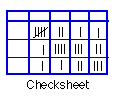
Check Sheet for Data Collection
Tool 2:
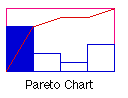
Pareto Diagram to prioritize which problem to tackle first
-
How to prioritize what problem to work on (80/20 rule)
-
'Vital Fews and Trivial Manys
-
How to construct a Pareto Diagram
Tool 3:
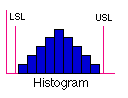
Histogram to analyze distribution of data
-
Characteristics of Histogram
-
How to construct a Histogram
-
How to interpret what the data is telling you
Tool 4:
Graphs for presentation and monitoring progress
Tool 5:
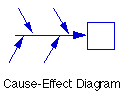
Cause & Effect (Fishbone) Diagram to identify possible causes
-
Characteristics and application of Cause & Effect Diagram
-
How to construct a fishone diagram.
-
The Do's & Don'ts in using a Fishbone diagram.
Tool 6:
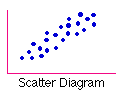
Scatter Diagram to study the relationship between two different parameters
-
Characteristics and application of Scatter Diagram
-
How to construct a Scatter Diagram
-
How to interpret a Scatter Diagram
Tool 7:
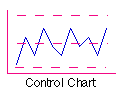
Introduction to Control Charts (for process monitoring)
-
Different types of Control Charts
-
Special & common causes in Control Charts
-
How to construct a basic Control Chart.
Case
Studies: Making Quality Improvement Decision
-
Business & quality
improvement decision.
-
Using PDCA approach
to problem solving.
-
Quality Team improvement
(QCC) Activities:
- -Brainstorming
- -Questioning techniques
- -Stratification method
- -Team presentation using quality improvement storyboard
MS Excel Exercises
-
Accelerated
method of constructing all the 7QC tools using
MS Excel.
-
Interpretation
of what the data/tools reveals.
-
Stratifications
and making decisions based on interpretation
of data.
**SPECIAL NOTE ** :
Computers (preloaded with MS Excel 2007 or above software) should be made available for participants to practice hands-on. Preferably participants bring along their own laptops as MS Excel working templates will be provided to equip participants to construct the QC tools back in their workplace.
Participant with prior knowledge/skill of basic MS Excel 2007 (e.g. edit tables, using formula, charting, etc) will help complement the accelerated learning objectives of this course.
|
|
|
|
|
|
who
should attend: |
|
-
Executives, Engineers,
Supervisors, QCC Facilitators
-
Team (Project/SGA/QCC/WIT) Leaders
& Members
-
7QC Tools is a foundational course for all Six Sigma learners and practitioners
|
|
|
|
| |
|
administrative
details : |
|
| Duration |
: 2 days |
| Time |
: 9.00am - 5.00pm |
| Venue |
: In-house or public program |
| Language medium |
: English |
|
|
| |
|
| |
|
Trainer
: |
|
|
|
| |
|
|
|
| |
|
| |
|

Click
on the above banner to find out more about other Accelerated
Learning Courses |
|
| |
|
 |
|
| |
|
|
|
|
|
|
| |
|
| |
|
|
|
|
 |
|
|
| |
|
|
|
|
|
Train for Personal Effectiveness
and Organizational Growth
© 2014 MyTrainingProvider.com, All Rights Reserved. | |
| |